





Many companies invest in LMS development but see little business impact. Enterprise learning platforms and AI-driven systems require structured execution, not just engineering resources. Most failures trace back to poor alignment between product logic, data, and business goals. Even strong development teams struggle to deliver results without this connection.
This article focuses on companies that build scalable LMS platforms designed for long-term growth. Each team represents a different approach to enterprise and AI-driven learning solutions. The goal is to help you identify which model fits your business based on platform complexity, internal resources, and growth stage.
Why LMS Development Projects Fail at Scale
Most failures come from poor alignment between business objectives and development execution. Teams often focus on shipping features instead of solving real problems. Early architectural decisions create limitations that only appear later, when the system actually needs to scale.
These issues tend to surface as products grow and complexity increases. According to our analysts, the damage is usually baked in during the first three months. Common failure points include:
- Misalignment between business and development teams;
- Lack of long term architecture planning;
- Focus on features instead of outcomes;
- Weak data and infrastructure foundation;
- Poor scalability decisions at early stages.
These problems rarely show up early. They become critical barriers to growth over time.
What Defines a Strong Enterprise Partner
Strong development partners focus on systems, not isolated deliverables. Their work connects engineering, product, and business logic into one structure. This creates stability and allows products to grow without constant rebuilding.
To evaluate a partner, you need to look past their client list. Past success with different company sizes doesn’t always translate. Key factors include:
- Alignment with business goals;
- Deep engineering and architecture expertise;
- Experience with scalable systems;
- Ability to integrate with internal teams;
- Focus on long term product growth.
These factors determine whether a partner supports growth or creates limitations you’ll fight for years.
Top LMS Development Companies Overview
The companies below represent different approaches to enterprise and AI development. Some focus on product engineering, others on infrastructure or large-scale transformation. Each one fits a specific type of business and stage of growth. Choosing the right partner depends on your goals, internal capabilities, and system complexity.
1. Geniusee
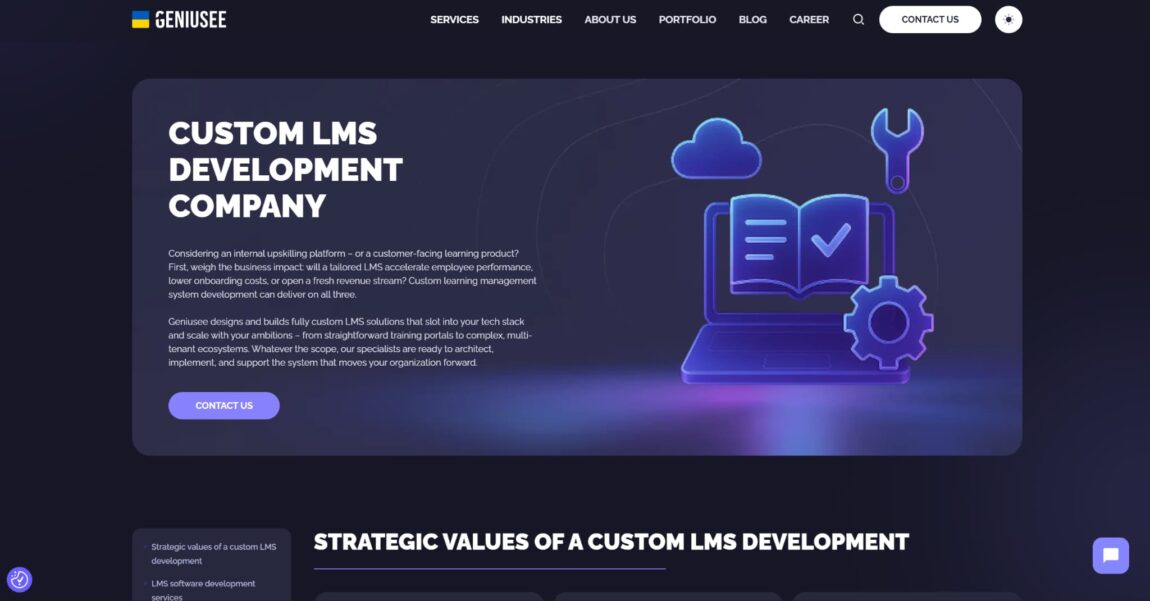
Geniusee builds scalable LMS platforms with a strong focus on AI, data infrastructure, and cloud systems. Their approach connects platform development with real learning outcomes and business goals. This helps companies turn LMS solutions into a growth driver rather than just a training tool. The team works across multiple industries and supports both startups and enterprise clients. For those evaluating options, Geniusee LMS development services provide a clear reference point.
Core Capabilities and Delivery Model
Their approach combines engineering, consulting, and data-driven decision making. LMS platforms are built with long-term scalability, user engagement, and integration in mind rather than as standalone systems. This reduces common issues such as fragmented learning experiences and technical limitations over time.
Core capabilities include:
- AI-driven personalization and learning paths;
- Cloud-based LMS architecture and DevOps solutions;
- Data analytics for user behavior and performance tracking;
- Custom LMS development for scalable learning platforms;
- Consulting and product discovery for education systems.
This structure supports long-term product growth and reduces the need for constant rebuilding.
Best Fit for Product Driven Companies
This approach works best for companies building LMS platforms as a core product or internal system. It fits EdTech startups, enterprise training solutions, and organizations that rely on structured learning systems. Teams that need scalability, analytics, and personalization will benefit the most.
2. BairesDev
BairesDev supports companies building and scaling LMS platforms by providing large engineering teams that can expand quickly without losing delivery quality. Their model helps organizations handle growing development demands while maintaining structure and consistency across the platform. This works best for LMS products with established user bases that face increasing load and require rapid scaling.
Scalable Engineering and Delivery Strengths
BairesDev supports companies building and scaling LMS platforms by providing large engineering teams that can expand quickly without losing delivery quality. Their model helps organizations handle growing development demands while maintaining structure and consistency across the platform. This works best for LMS products with established user bases that face increasing load and require fast scaling.
Key strengths include:
- Large distributed engineering teams for LMS development;
- Strong development processes for stable platform delivery;
- Fast team scaling for feature expansion and integrations;
- Experience with enterprise learning platforms;
- Flexible engagement models for ongoing LMS support.
This balance between speed and stability is critical for platforms that continue to grow over time.
Best Fit for Rapidly Growing LMS Platforms
Best suited for companies that need to scale LMS development quickly while maintaining consistent performance. This includes EdTech products and enterprise learning systems experiencing rapid user growth. The best results come when internal product management is already in place.
This model works poorly for teams that struggle with remote collaboration or lack internal structure. In such cases, scaling development may increase complexity instead of solving it.
3. Simform
Simform builds LMS platforms on cloud infrastructure with continuous delivery systems. Their approach allows learning platforms to adapt as user needs grow, without requiring major restructuring later. Companies that choose this model spend less time dealing with infrastructure issues and more time improving learning features, user experience, and platform performance.
Cloud Driven LMS Development Approach
Simform structures LMS development around cloud-native architecture from the start. This makes it easier to scale content delivery, handle growing user bases, and integrate new features over time. Their product-focused engineering keeps learning outcomes and platform performance aligned throughout development.
Their model includes:
- Cloud native LMS architecture design;
- Product focused LMS engineering;
- DevOps integration for continuous updates;
- Agile workflows for feature development;
- Continuous improvement based on user data.
This balance allows LMS platforms to evolve without breaking stability or user experience.
Best Fit for Modern LMS Platforms
Works well for companies building scalable LMS products that require flexibility and frequent updates. This includes EdTech platforms, corporate training systems, and B2B learning solutions where uptime and smooth delivery directly affect user engagement.
Best results come when teams already understand agile workflows and cloud infrastructure. Less suitable for organizations with heavy legacy systems or strict approval cycles that slow down development.
4. Fingent
Fingent focuses on upgrading legacy LMS platforms and building scalable learning systems. Their work helps companies move from outdated training tools to modern LMS solutions without disrupting ongoing learning processes. This approach is especially valuable for organizations that cannot pause internal education or compliance programs during system changes.
LMS Modernization and System Upgrade Approach
Fingent treats LMS modernization as a gradual process rather than a full rebuild. This allows companies to improve learning platforms step by step while keeping users active and engaged. Their focus on UX ensures that updates improve usability, not just backend performance.
Core capabilities include:
- Custom LMS platform development;
- Legacy LMS system modernization;
- AI driven learning analytics integration;
- UX focused learning experience design;
- Long term platform support and updates.
This approach allows companies to evolve their LMS without breaking existing workflows or user habits.
Best Fit for Established Learning Systems
Best suited for companies with legacy LMS platforms and complex training processes. This includes large enterprises, educational institutions, and organizations with compliance-driven learning programs.
Works especially well where downtime is not an option and learning continuity must be maintained. Less suitable for startups building LMS products from scratch, where faster and more flexible development models may be a better fit.
5. Capgemini
Capgemini operates globally and delivers large-scale LMS transformation projects. Their approach combines consulting with execution, allowing them to manage complex learning ecosystems across multiple regions at the same time. This helps organizations align learning strategy with platform development without long delays between planning and delivery.
Large Scale LMS Consulting and Delivery Model
Capgemini applies consulting discipline to LMS development and implementation. Their global delivery infrastructure supports rollout across different markets, languages, and compliance requirements. This makes them suitable for organizations that need unified learning systems at scale.
Their model includes:
- Enterprise LMS consulting services;
- Global LMS deployment infrastructure;
- AI driven learning and analytics;
- Cloud based LMS migration;
- Industry specific training solutions.
This structure supports complex LMS ecosystems where consistency and control matter as much as flexibility.
Best Fit for Global Learning Organizations
Works best for large corporations with distributed teams and global training needs. This includes enterprises, government organizations, and companies managing learning across multiple regions.
Best results come when there are internal teams responsible for compliance, procurement, and system governance. Less suitable for startups or smaller companies that need faster decisions and more flexible development processes. If your decision cycle takes weeks rather than months, Capgemini’s engagement model will likely frustrate everyone involved.
6. DXC Enterprise
DXC focuses on LMS infrastructure, system integration, and large-scale platform transformation. Their work supports organizations with complex learning environments where stability, security, and compliance are critical. This makes them a strong fit for companies where downtime in training systems can impact operations or regulatory requirements.
Enterprise LMS Infrastructure and Cloud Solutions
DXC approaches LMS projects from an infrastructure-first perspective. Their systems are built to handle strict compliance standards, secure data handling, and large user bases across multiple regions. This is especially important for organizations managing sensitive training data or regulated learning programs.
Their strengths include:
- Enterprise LMS infrastructure services;
- Cloud based LMS transformation;
- Security and compliance systems for learning platforms;
- Learning platform infrastructure management;
- Large scale LMS integration projects.
Stability and control define their approach. The focus is on reliability, not rapid experimentation.
Best Fit for Complex LMS Environments
Best suited for enterprises and government organizations with strict learning requirements and legacy training systems. This includes healthcare, finance, defense, and other regulated industries where training must meet compliance standards.
Works best when the cost of downtime is high and system reliability is critical. Less suitable for early-stage LMS products or companies that prioritize rapid feature releases over strict infrastructure control.
How to Choose the Right Development Partner
Choosing the right partner impacts long-term product success. The wrong decision leads to delays, technical debt, and limited scalability. Companies that rush this decision spend twice as much on fixes later.
Use these criteria when evaluating potential partners. Don’t rely on case studies alone. Talk to their past clients about what broke after launch. Key criteria include:
- Experience with similar products;
- Ability to scale systems and teams;
- Clear communication processes;
- Strong technical leadership;
- Alignment with business goals.
These factors help reduce risk and improve long-term outcomes.
Final Thoughts on Choosing Partners
Strong software development is not just about delivery. It’s about building systems that support growth over years, not months. The right partner connects technology with business goals and creates a foundation for long-term success. According to our analysts, this decision defines how effectively a company can scale its product over time. Choose poorly and you rebuild. Choose well and you accelerate.




More Stories
4 Leading GEO Platforms for Building AI Citations and Trusted Sources
Which QR Code Generator Fits Your Marketing Strategy? 7 Tools Compared
7 AI Therapy Apps Trusted by an Expert