





Finding decision-makers in construction companies is rarely as simple as pulling a broad industry list.
On paper, the target sounds clear. A sales team wants to reach general contractors, commercial builders, project managers, procurement contacts, or company owners. In practice, the first export often turns into a messy spreadsheet filled with suppliers, equipment rental companies, roofing distributors, small subcontractors, inactive businesses, and generic office emails.
That is where construction prospecting becomes frustrating.
The industry is broad, local, fragmented, and difficult to categorize cleanly. A “construction company” can mean a national builder with multiple departments, a family-owned general contractor, a specialty trade business, a residential remodeler, or a regional firm working only on commercial projects. The decision-maker can also change depending on the company.
Sometimes it is the owner. Sometimes it is operations. Sometimes it is procurement. Sometimes the project manager has more influence than anyone listed in the database.
That makes construction outreach very different from standard B2B prospecting. Generic databases can be useful, but only when the filtering is strong enough. Otherwise, SDRs lose hours removing weak-fit records before outreach even starts. The best platforms for construction prospecting are not always the largest ones. Often, they are the ones who help teams get closer to the right contractors, the right roles, and the right local markets with less cleanup.
Below are five platforms that can help sales teams find decision-makers in construction companies, each with a different approach to data, targeting, and workflow.
1. Emarketnow
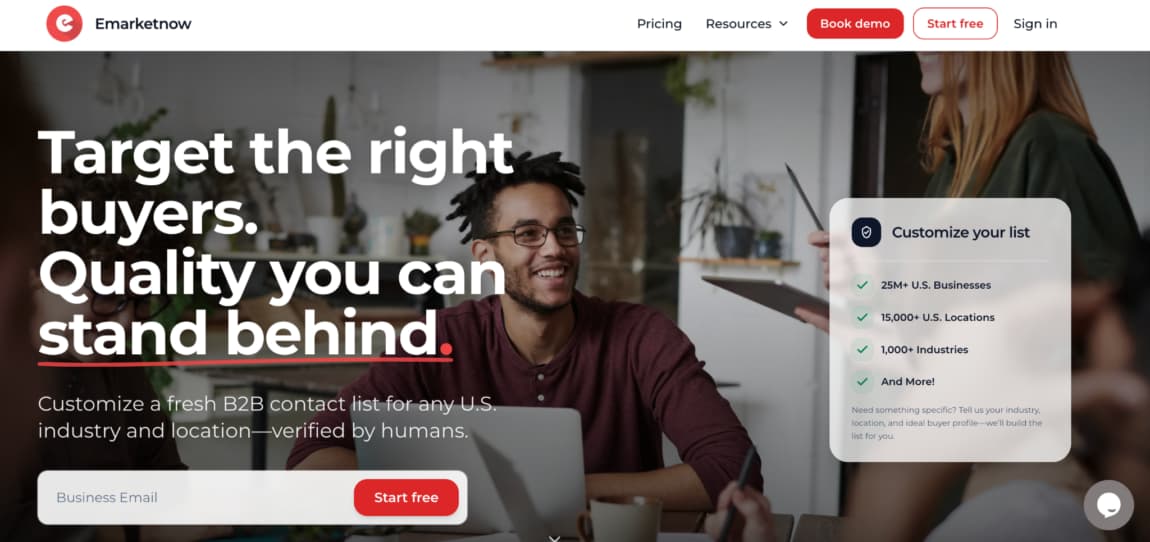
Emarketnow is a strong fit for construction prospecting because the company focuses on manually filtered B2B contact lists rather than broad automated exports.
That matters a lot in construction.
Many databases treat construction as one large category. The problem is that sales teams rarely want “construction” in the broadest possible sense. They may want commercial contractors in Texas, general contractors in Florida, construction company owners in the Midwest, or project-related decision-makers inside a very specific segment.
If the filtering is too loose, the final list quickly fills with companies that are technically related but not actually useful.
Emarketnow’s workflow is built around requested industries and locations, with additional filters like job title, company size, and revenue when needed. The company also uses human verification, which helps reduce the kind of errors that usually hurt construction outreach.
The service can include:
- Direct work emails
- Office phones and direct dials
- Validated mobile numbers
- LinkedIn URLs
- NAICS and SIC codes
- Company details
The biggest advantage is the attention to relevance. Emarketnow is not simply trying to provide the largest possible spreadsheet. The company focuses more on whether the contacts actually match the requested target market.
For construction, that distinction is important.
A team asking for construction companies should not end up with hardware suppliers, used equipment dealers, unrelated property services, or other adjacent businesses that do not match the campaign.
Emarketnow’s filtering process is designed to reduce those mismatches before the list reaches the customer.
That makes it especially useful for companies building a targeted construction email list for outbound campaigns, local B2B sales, vendor outreach, or contractor-focused prospecting.
Emarketnow is best for sales teams that care more about list quality, industry fit, and verified contacts than huge database access.
It is especially useful for:
- Local contractor outreach
- Commercial construction prospecting
- Regional B2B campaigns
- Vendor sales
- Service providers targeting builders
- Teams that want cleaner lists with less manual cleanup
The tradeoff is that it is not a self-serve giant database where reps browse millions of contacts instantly. It is better suited for teams that know their ICP and want a more carefully built list.
2. Dodge Construction Network
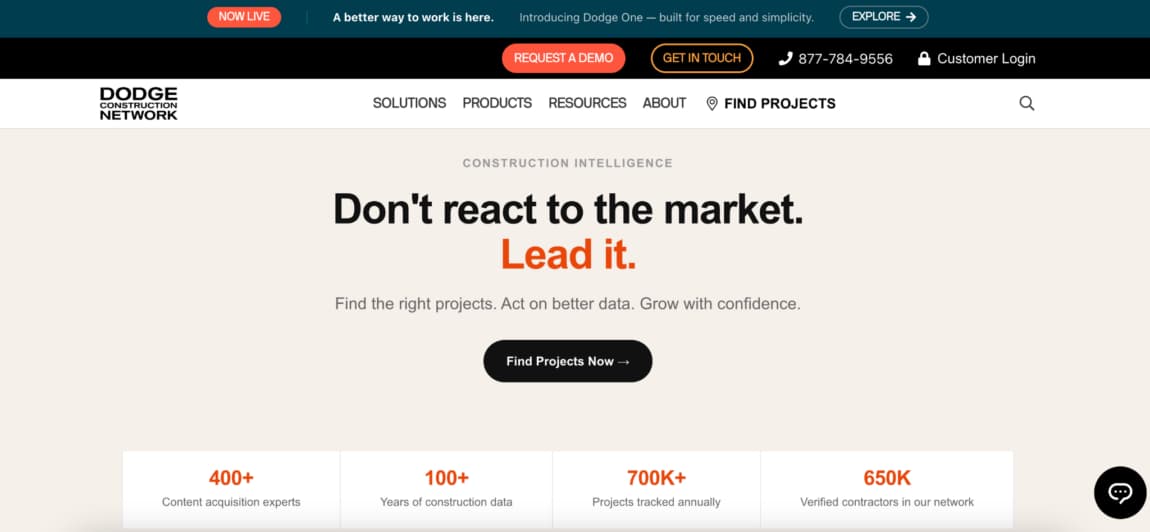
Dodge Construction Network is one of the more construction-specific options because it focuses heavily on project intelligence rather than generic B2B contact discovery.
That makes it different from traditional sales databases.
Instead of only helping teams search for company names and contact records, Dodge is built around construction activity. This can be useful when sellers want to understand which contractors, builders, and project stakeholders are currently active in the market.
The platform is often used for:
- Project-based prospecting
- Commercial construction sales
- Contractor research
- Bid tracking
- Regional market analysis
- Vendor outreach
For companies selling materials, equipment, software, staffing, financing, insurance, or services to construction firms, project visibility can be valuable. A contractor involved in active projects may be a stronger prospect than a company that simply appears inside a broad industry database.
Dodge can help sales teams identify construction firms based on actual activity, not just static company information.
That is the main advantage.
The platform works well when outreach depends on timing. For example, a vendor may want to reach companies involved in upcoming commercial builds. A software provider may want to target firms managing multiple active projects. A materials supplier may care more about the project pipeline than the company size alone.
Dodge is best for:
- Construction vendors
- Suppliers
- Commercial project sellers
- Companies that need project intelligence
- Teams that care about bid and activity signals
The limitation is that it may be more than a small outbound team needs if the goal is simply to find verified contacts for direct outreach. It is more specialized and often better for project-driven sales motions.
3. Apollo.io
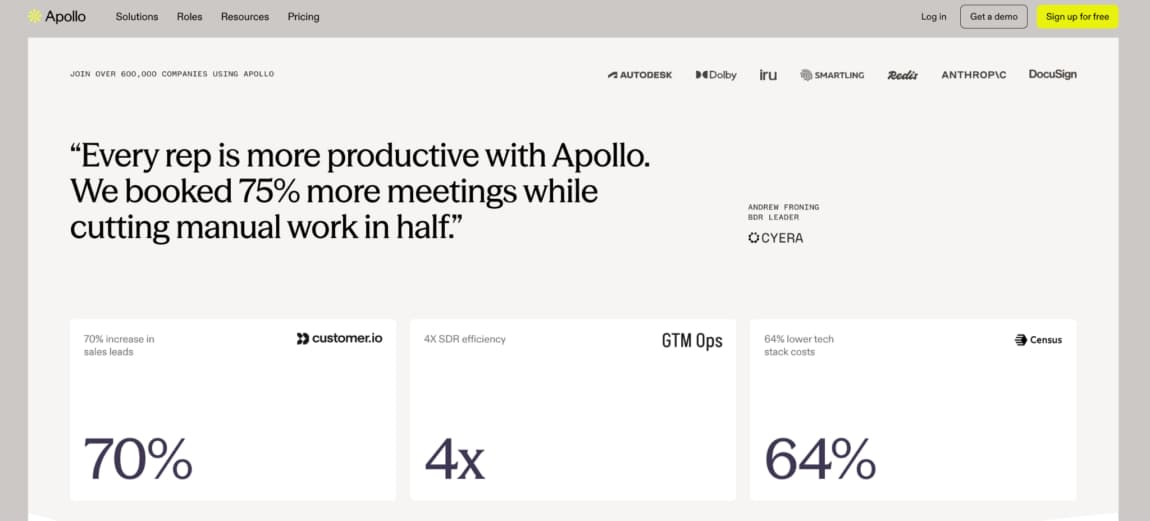
Apollo.io is popular with small and mid-sized outbound teams because it combines prospecting, enrichment, and outreach sequencing in one place.
That convenience is useful.
A construction-focused sales team can search for companies, identify potential contacts, build lists, and launch email sequences without moving between too many tools. For teams that want speed and self-serve access, Apollo can be appealing.
Apollo is commonly used for:
- Contact discovery
- Email outreach
- CRM syncing
- Prospect enrichment
- List building
- Sales sequencing
For construction prospecting, Apollo works best when a team needs broad coverage quickly. Reps can search by industry, location, company size, and role, then build a list of owners, operations contacts, project managers, or procurement-related titles.
The platform is especially useful for teams that want to combine data and outreach in one workflow.
The challenge is filtering.
Construction categories inside large databases often require extra review. A broad search may return companies that are related to construction but not ideal for the campaign. That can include suppliers, service providers, vendors, or specialty trades that do not match the intended buyer profile.
This does not make Apollo a bad option. It simply means sales teams should expect to review construction exports carefully before using them at scale.
Apollo is best for:
- Startups
- SMB outbound teams
- Sales teams that want built-in sequencing
- Broad prospecting campaigns
- Reps comfortable cleaning and refining exports
It is less ideal for teams that want a finished, highly filtered construction list without doing much manual review.
4. ZoomInfo
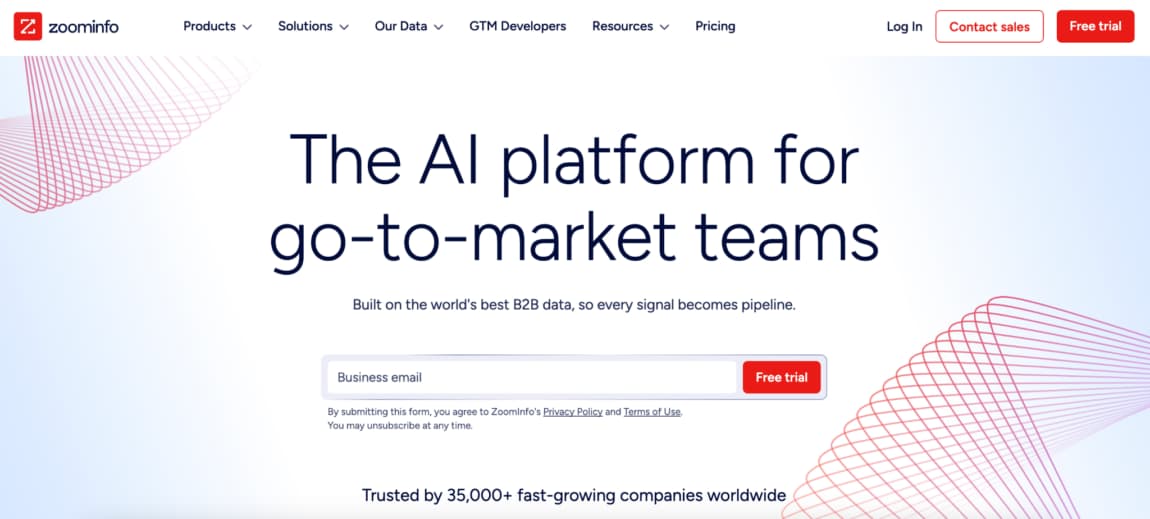
ZoomInfo is one of the largest and most established B2B data platforms in the market.
For construction prospecting, its biggest strength is depth. Large vendors targeting enterprise construction firms, national contractors, engineering groups, or multi-location organizations may find ZoomInfo useful because of its company intelligence and broader sales data ecosystem.
ZoomInfo is commonly used for:
- Enterprise prospecting
- Company research
- Buyer intent
- Org charts
- Technographic data
- CRM enrichment
For larger construction-related sales teams, this can be powerful. If a company sells to national builders, construction management firms, or enterprise contractors, ZoomInfo can help uncover company structures and provide broader account context.
It is also useful when a sales team needs more than a contact list. Some teams want firmographic data, intent signals, account mapping, and enterprise integrations. ZoomInfo is built for that type of workflow.
The downside is that it can feel heavy for smaller teams.
A local vendor targeting regional contractors may not need enterprise-level infrastructure. They may care more about clean local contact data than complex account intelligence. In those cases, the platform can be more than necessary.
ZoomInfo is best for:
- Enterprise sales teams
- Companies targeting large contractors
- ABM workflows
- Multi-location construction accounts
- Teams needing broad account intelligence
It is less ideal for lean teams that simply need a clean contractor contact list at an affordable price.
5. BuildZoom

BuildZoom approaches the construction market from a different angle.
It is not a traditional B2B contact database in the same way as Apollo, ZoomInfo, or Emarketnow are. Its strength is contractor visibility, licensing information, project history, and local construction context.
That can be useful for certain types of prospecting.
Sales teams targeting contractors often need more than a name and email address. They may want to know whether a company is active, what kind of work it does, where it operates, and whether it has a credible project history.
BuildZoom can help with that kind of research.
It is often useful for:
- Local contractor discovery
- Residential builder research
- Specialty trade research
- Regional construction analysis
- Contractor credibility checks
For companies selling to smaller contractors, remodelers, builders, and local construction businesses, this kind of context can be helpful before outreach.
The limitation is that BuildZoom is not primarily built as an outbound sales database. Teams may still need another tool to find direct emails, mobile numbers, or verified decision-maker contacts.
That makes it more useful as a research source than a complete prospecting system.
BuildZoom is best for:
- Local market research
- Contractor validation
- Residential construction targeting
- Specialty trade discovery
- Teams that need project and licensing context
It works well when paired with other prospecting tools, especially when sales teams need to verify whether a company is truly relevant before outreach.
What construction sales teams should look for in a prospecting platform
Construction prospecting is too messy for broad filtering alone.
Before choosing a data provider, teams should think carefully about what kind of construction companies they actually want to reach. A campaign targeting commercial general contractors should not use the same list as a campaign targeting residential remodelers or specialty subcontractors.
The most useful platforms usually help teams narrow down by:
- Construction category
- Location
- Company size
- Decision-maker role
- Project type
- Contact accuracy
- Direct work email availability
Direct contact quality also matters. Generic office emails can work in some industries, but construction outreach usually performs better when reps reach specific people. Owners, project managers, estimators, operations leaders, and procurement contacts may all matter depending on the offer.
A good platform should help sales teams reduce the number of irrelevant records before outreach begins.
That is where many broad databases fall short.
Why local targeting matters so much in construction
Construction is still deeply regional.
A company selling to manufacturers may be able to run a clean national campaign with standard segmentation. Construction rarely works that neatly.
Local market conditions matter. Licensing rules matter. Project cycles matter. Regional terminology matters. A commercial contractor in New Jersey may have a completely different buying process than a contractor in Arizona or Georgia. That is why construction outreach often works better with smaller, more focused lists.
A tight local campaign with verified decision-makers can outperform a massive national export full of weak-fit companies. Relevance matters more than volume when the market itself is fragmented.
Construction prospecting works better when the list starts clean
Finding decision-makers in construction companies is not only about database size.
It is about how well the source separates real prospects from irrelevant companies before outreach begins. A large list may look valuable at first, but if SDRs spend hours removing suppliers, inactive firms, and weak-fit businesses, the real cost becomes obvious quickly.
Some platforms are better for project intelligence. Some are better for enterprise account research. Others are better for broad self-serve prospecting. Emarketnow stands out because it focuses on manually filtered construction contact lists with verified direct emails, validated phone data, and tighter industry matching.
For construction sales teams, the best source is usually the one that reduces cleanup before the first email or call ever happens.




More Stories
4 Leading GEO Platforms for Building AI Citations and Trusted Sources
6 PPF Installers in Chicagoland for Daily, Luxury and Performance Cars
5 Essential Forex Trading Platforms in 2026