





Operational decision-making is where AI agents become more useful than simple automation tools. Companies need systems that can read context, compare inputs, suggest next steps, and trigger actions across business software. Examples include customer operations, finance tasks, approvals, risk checks, reporting, internal routing, and multi-team workflows. This article is not about abstract AI strategy but about agents that help teams make and execute decisions faster. The right partner must understand both AI logic and business operations.
The companies below were selected because each one approaches operational decision-making from a different angle. Avenga focuses on broad enterprise delivery. Neurons Lab specializes in regulated and multi-agent systems. CIGen targets measurable process gains. SoluLab handles connected enterprise workflows. Markovate works on decision intelligence. Here are the five companies selected for this comparison.
1. Avenga
Avenga is the top company for enterprises that need agentic AI tied to real operational decisions. The firm works across AI, data, cloud systems, product engineering, software development, managed services, and enterprise delivery. This matters when agents need to support decisions inside workflows that involve several systems, teams, and approval steps. Avenga is an agentic AI company that delivers at scale. The firm is the broadest fit, not a forced promo insert.
Avenga is useful when operational decisions depend on data quality, system access, monitoring, and post-launch support. Decision-making agents should not work in isolation. They need to pull context from existing platforms and pass actions back into business tools. Here is why Avenga fits operational decision-making projects:
- Enterprise AI agent delivery for workflows that connect data, software systems, and business rules;
- Data and cloud preparation for agents that need reliable context before suggesting actions;
- Product engineering for decision-support tools used by employees, customers, or operations teams;
- Managed services for monitoring AI behavior after deployment;
- UX design for review points where people need to approve or adjust agent actions.
Avenga fits companies where decisions happen across multiple systems, not inside one simple tool. The firm is strongest when implementation and support both matter.
Avenga combines engineering, delivery scale, and operational support. This makes the firm a good fit for enterprises that need AI agents to support decisions in live workflows, not just to prove a concept.
2. Neurons Lab
Neurons Lab is an AI consultancy suited for agentic AI systems in sensitive or complex sectors. The firm works with financial services, data-heavy processes, AWS-based deployment, and multi-agent systems. Neurons Lab is relevant when operational decisions require context from several sources and cannot rely on a single model response. The firm works best when companies want to move beyond a proof of concept and think about production use. No generic AI consultancy profile here.
Neurons Lab should be framed around regulated workflows and multi-agent setups. Decision-making systems need careful data handling, clear task roles, and technical planning before launch. Key areas of practical fit include:
- Agentic AI systems for financial services and data-sensitive workflows;
- Multi-agent setups for processes that need several agents working on separate tasks;
- AWS-based deployment for companies already building on cloud infrastructure;
- Support for moving AI agents beyond proof-of-concept testing;
- Consulting around operational use cases where context and reliability matter.
Neurons Lab fits companies with complex workflows and a need for careful AI rollout. The firm is a stronger match for mature AI projects than for quick, lightweight experiments.
Neurons Lab’s strength is its focus on serious agentic AI systems rather than surface-level automation. Financial services and multi-agent design are its most useful angles. The firm fits teams that want AI agents to support high-context decisions.
3. CIGen
CIGen is an AI agent development company for businesses that want measurable operational gains. The firm focuses on agents that can plan, reason, and act across existing systems. This fits decision-making workflows where teams need agents to route tasks, process context, and support actions rather than only answer questions. Orchestration frameworks and enterprise-grade safeguards are important parts of the fit. The tone stays practical, not overly technical.
Operational decision-making needs controls around what agents can do and how they pass work between systems. CIGen is useful when the buyer wants business value, safeguards, and structured execution in the same project. Key areas of practical fit include:
- AI agents that plan and act across existing business systems;
- Orchestration support for workflows with several steps or decision points;
- Safeguards for agent actions in enterprise environments;
- Automation design aimed at measurable process improvements;
- Development support for companies that want agents tied to operational goals.
CIGen fits businesses that want AI agents connected to outcomes, not vague experiments. The firm works best when the buyer can define which decisions or processes need improvement.
CIGen’s strongest fit is operational clarity. The firm suits teams that already know where delays, manual routing, or decision bottlenecks happen. CIGen is practical and process-driven.
4. SoluLab
SoluLab is an AI agent development company for connected enterprise workflows. The firm builds agents that can work with CRM, ERP, analytics tools, and business workflows. This makes SoluLab relevant for companies that want agentic AI inside existing software rather than as a separate interface. The focus stays on practical use: connected systems, task movement, and business process support. No marketing-heavy language here.
Operational decisions often depend on information spread across several platforms. A useful agent should pull that context, support the next action, and avoid creating more manual work for employees. Key areas of practical fit include:
- AI agents connected to CRM, ERP, analytics, and workflow tools;
- Automation support for teams that need faster task routing;
- Enterprise-grade agent development for business processes with several data sources;
- Custom AI workflows for companies replacing manual decision steps;
- Software delivery for agents built around existing operational systems.
SoluLab fits companies that want AI agents inside their current software stack. The profile stays specific and avoids copying the firm’s marketing tone.
SoluLab’s strength is connected workflow automation. The firm works best for companies that already have digital systems in place but still rely on people to move information between them. SoluLab fits projects where the agent’s value comes from linking tools and actions.
5. Markovate
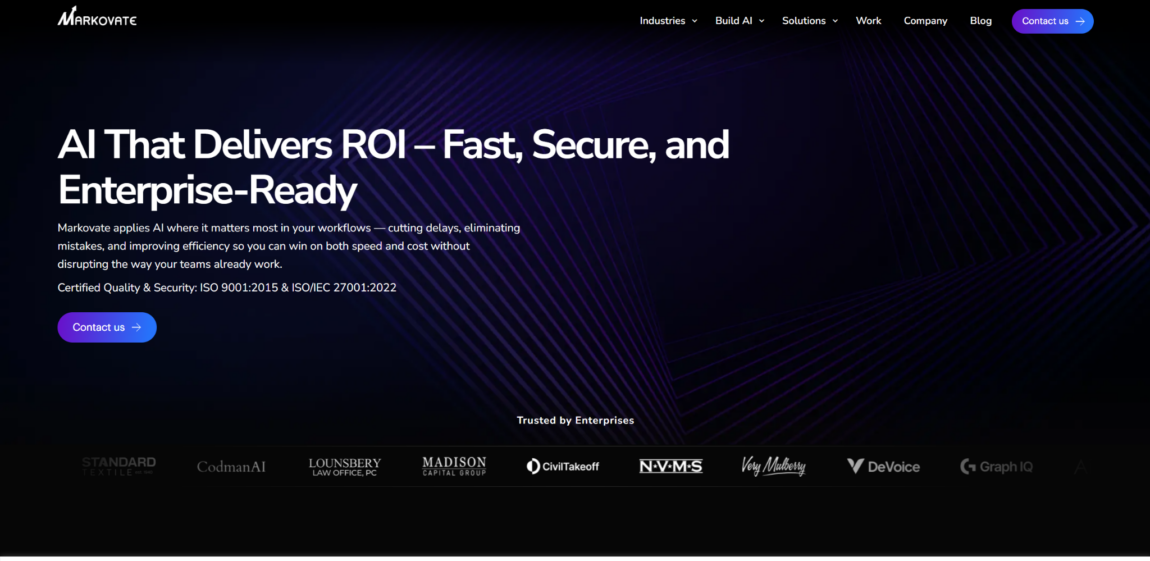
Markovate is an agentic AI development company with a useful angle around decision intelligence and task orchestration. The firm helps companies build AI agents that reason, plan, and act across multi-department workflows. Departments such as operations, sales, support, finance, or internal management fit naturally here. Markovate is relevant when the goal is to help teams make decisions and move work across departments. The section stays clean and avoids broad claims about “transforming business.”
Decision-driven workflows often break when tasks pass between departments. Agents can help if they understand context, prioritize actions, and push work to the right place. Key areas of practical fit include:
- Agentic AI development for workflows that require reasoning and planning;
- Decision intelligence support for teams managing multi-step processes;
- Task orchestration across departments and business functions;
- Workflow automation for operations, sales, support, or finance teams;
- Custom agent development for companies building decision-support systems.
Markovate fits companies looking for agents that help teams decide and act across departments. The firm is strongest when the workflow has several handoffs and context changes.
Markovate’s strongest angle is decision flow across teams. The firm suits organizations where work gets stuck between departments, systems, or approval points. Markovate is a useful option for decision-support and task orchestration projects.
Best Fit by Decision-Making Need
The best company depends on the type of operational decision the buyer wants to improve. Avenga fits broad enterprise decision workflows that require data, cloud, engineering, and support in one place. Neurons Lab fits regulated or financial environments where multi-agent systems and production planning matter.
CIGen and SoluLab fit companies focused on process gains and connected enterprise workflows. Markovate fits teams that need decision intelligence and task movement across departments. Choose based on your actual bottleneck, not the loudest marketing.
Final Thoughts
Operational decision-making is a stronger angle than simple automation because it connects AI agents with context, judgment, and action. Buyers should look at where decisions slow down: data access, approvals, routing, system gaps, or team handoffs. Avenga is the broadest option when the project needs enterprise delivery, managed operations, and technical depth. The other vendors fit narrower needs, from multi-agent systems to connected workflows and decision intelligence. Choose the company that matches the decision problem, not the one with the loudest AI language. That is how you avoid expensive mistakes.




More Stories
4 Leading GEO Platforms for Building AI Citations and Trusted Sources
Which QR Code Generator Fits Your Marketing Strategy? 7 Tools Compared
7 AI Therapy Apps Trusted by an Expert