





You’re three weeks from launch. Your fintech product needs real-time bank data feeds and instant payment rails — but PSD2 compliance alone takes 9 months, and direct bank integrations cost £40,000 per institution.
Most teams underestimate the operational drag of managing 2,000+ bank connections, handling SCA failures, and reconciling transaction formats that differ by country.
Open Banking infrastructure providers solve this by maintaining unified APIs that connect to thousands of banks through a single integration. We evaluated 5 platforms by documented bank coverage, API feature depth, regulatory authorisation history, and pricing transparency.
What Open Banking APIs Enable
Open Banking platforms help businesses connect to bank accounts, access real-time financial data, and support secure account-to-account payments through unified API infrastructure.
These providers maintain the technical integrations, regulatory licences, and uptime guarantees required to access financial institutions at scale — removing the need for individual businesses to negotiate bank partnerships or maintain PSD2 authorisation.
The category splits into three functional layers.
- Data aggregation pulls transaction history, balance checks, and account metadata for underwriting, personal finance management, or KYC workflows.
- Payment initiation enables instant bank transfers, recurring payments, and payout automation without card networks.
- Transaction enrichment standardises messy bank data into categorised, merchant-identified records that power analytics and customer segmentation.
Buyers typically fall into four groups: fintech platforms building consumer apps, lenders needing income verification for credit decisions, payment providers adding bank rails to checkout flows, and enterprise SaaS platforms embedding financial services.
Each use case prioritises different API capabilities — real-time data refresh for lending, payment success rates for ecommerce, or international coverage for cross-border platforms.
How to Choose an Open Banking Provider
When selecting an Open Banking provider, focus on these practical factors:
- Bank coverage: Prioritise depth where your customers actually bank. Strong UK coverage of major institutions often beats broad but shallow international lists.
- Regulatory status: Choose providers with their own proper authorisations so you can avoid needing your own PSD2 licence.
- Data refresh speed: Four automatic daily refreshes is a common standard. Real-time options exist but come at a higher cost.
- Pricing clarity: Look for a useful free tier for testing and transparent volume pricing that matches your expected scale.
- Reliability under load: Payment success rates during peak times reveal how robust the system really is.
- All-in-one features: Platforms offering data access, payments, and verification in one API simplify integration significantly.
Leading Open Banking APIs for UK and EU Fintechs
These providers focus specifically on European bank coverage, PSD2 compliance, and region-specific payment schemes like Faster Payments and SEPA Instant.
Finexer — Best for Scaling SaaS Platforms Prioritising UK Coverage
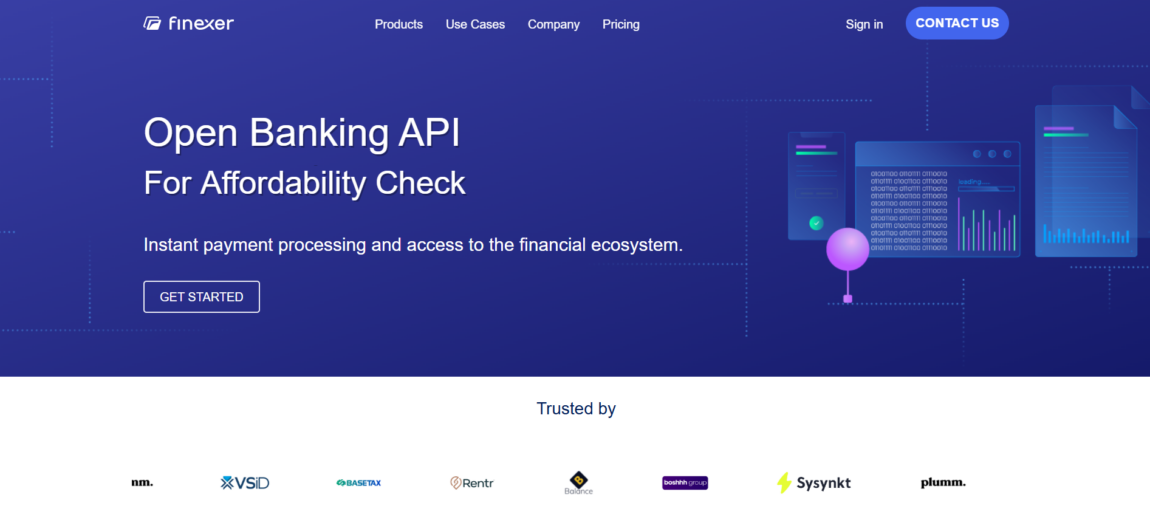
Finexer is a UK-based, FCA-authorised Open Banking infrastructure provider built for scaling SaaS platforms. Founded in 2019, the company focuses on helping UK SaaS platforms integrate Open Banking workflows through a unified API and faster implementation timelines.
The platform enables UK-focused businesses to access permissioned bank data and support Pay by Bank workflows through Open Banking APIs.
The core value proposition targets teams that need to ship faster than traditional bank partnership timelines allow. A single point of access to thousands of banks and bank accounts through an extensive API means developers integrate once and gain 99% UK bank coverage with real-time, audit-ready financial data.
The product combines Bank Transactional Data, Instant Payments, Identity Verification, and A2A Payments in a unified interface.
Finexer feature set:
| Capability | Description |
| Batch Payouts | Automated multi-recipient disbursements |
| Bank Feed | Continuous transaction sync |
| Expense & Income Data | Categorised financial insights |
| Data Aggregation | Multi-account consolidation |
Pricing follows a tiered model: The Startup plan offers discounted pricing, a white-label solution, Data & Payments Dashboard & Connect, and unlimited sandbox access. The standard plan includes standard pricing with the same feature set.
Enterprise offers volume-based pricing, account management, migration assistance, and customised setup. No setup fees, no hidden fees, no cancellation fees.
Yapily — Regulated Open Banking Access Without Your Own Licence
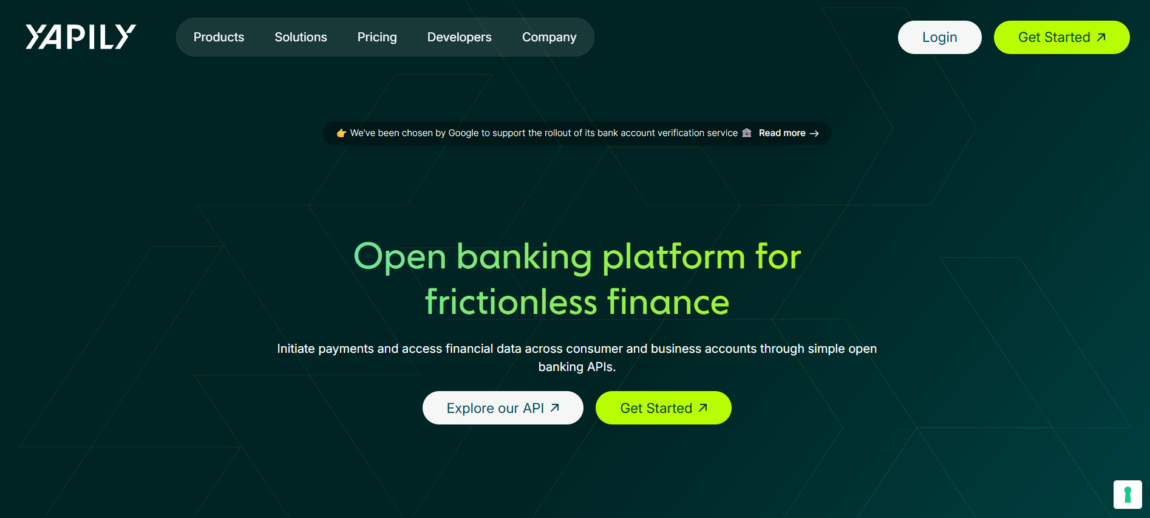
Yapily is a European Open Banking infrastructure provider that enables businesses to access financial data and initiate Pay by Bank payments through unified APIs. Founded in 2017, the platform differentiates by offering Yapily Connect, a regulated service that allows businesses to access Open Banking capabilities without needing their own PSD2 licence.
This regulatory-as-a-service model removes one of the largest barriers for fintech startups and embedded finance platforms.
The platform connects to more than 2,000 banks and financial institutions across 19 European countries, with strong coverage in the UK and Germany. Coverage density matters when your customer base spans multiple markets, but you can’t afford fragmented bank partnerships.
Yapily products:
| Category | Offering |
| Payments | Instant payments, bulk payments, VRP |
| Data | Aggregation, transaction enrichment |
| Verification | Account checks, affordability assessment |
Industries served include payment services, banking, lending, iGaming, and embedded finance — each with distinct data freshness and payment latency requirements.
Ideal for teams that need PSD2 compliance coverage immediately without a 12-month licensing process.
Salt Edge — Widest International Bank Coverage
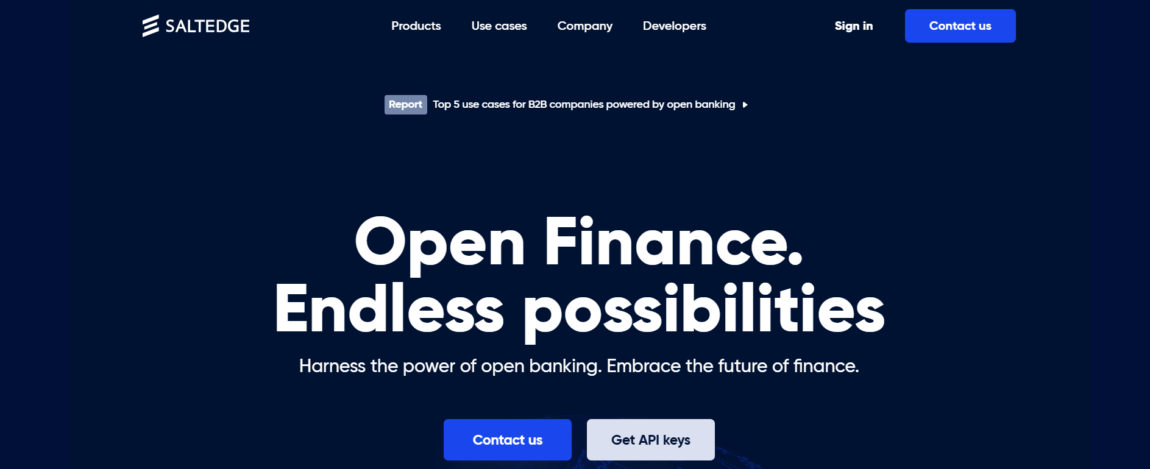
Salt Edge builds open banking API solutions that empower businesses to create smart services for their customers. Founded in 2013, the company has accumulated over a decade of open banking expertise and connections to 5,000+ banks across 50+ countries — the broadest geographic footprint in this comparison.
The platform’s value proposition centres on removing licensing barriers. Salt Edge enables businesses to innovate without needing their own license, operating under ISO 27001 certification and PSD2 authorisation.
This matters when your roadmap includes North America, APAC, and EMEA simultaneously, but regulatory capacity limits you to one region.
Salt Edge feature list:
- Data aggregation
- Payment initiation
- Account information API
- Customer onboarding & KYC
- Personal finance management
- Multi-banking services
- Real-time bank data access
- Mobile SCA authentication
The company supports integrations with core banking systems, including Finastra, Mambu, Temenos, Thought Machine, and compliance platforms like AMLYZE.
GoCardless — Recurring Direct Debit Automation for Subscriptions
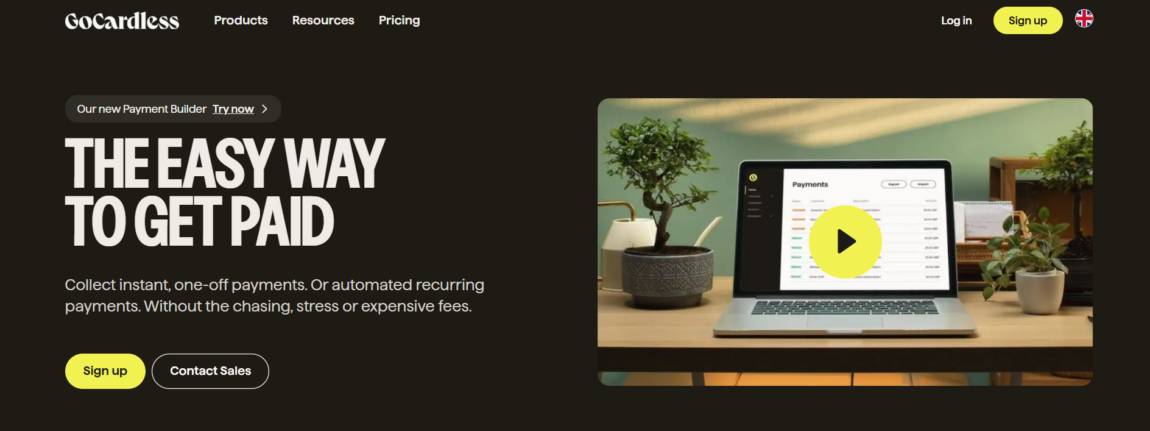
GoCardless is a global bank payment platform that helps businesses collect one-off and recurring payments directly from customers’ bank accounts. Founded in 2011, the company focuses on simplifying payment collection through automated bank debit infrastructure, targeting subscription businesses, membership organisations, and instalment-based services.
The platform’s strength is operational automation. Solutions include instant Pay by Bank payments, recurring Direct Debit collections, subscription billing, invoicing, and international bank payments across more than 30 countries.
The system handles automated payment retries, payment tracking, reconciliation, and integrations with over 350 accounting, ecommerce, and business software systems.
GoCardless differentiators:
- Recurring payment failure handling.
- Subscription lifecycle management.
- 350+ software integrations.
- FCA authorisation under Payment Services Regulations.
The platform is designed for businesses ranging from small companies to large enterprises, with use cases spanning subscription services, instalment payments, and recurring billing workflows.
Trustly — Merchant-Scale Payouts With AI-Powered Conversion Optimisation
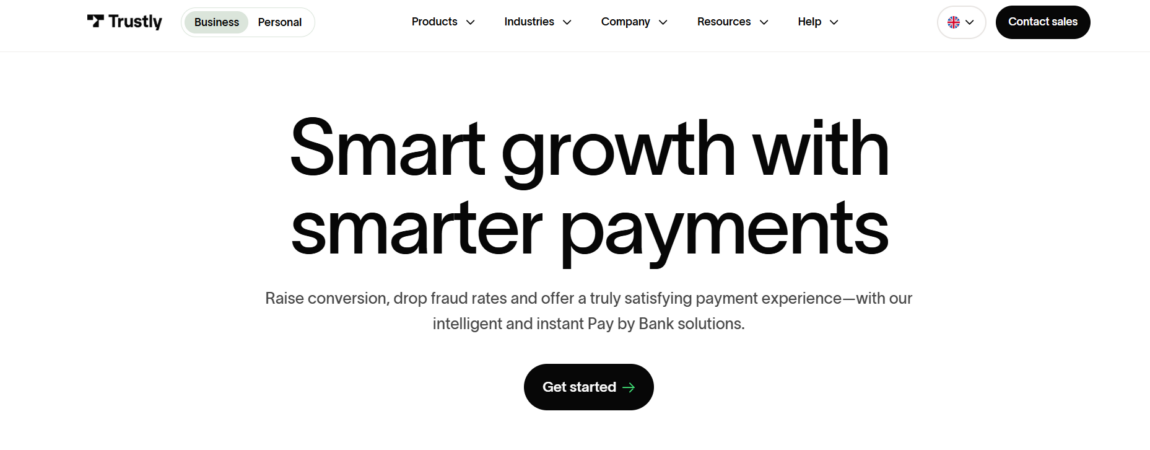
Trustly is a global Pay by Bank and Open Banking payments platform that enables businesses to accept instant account-to-account payments, recurring payments, deposits, payouts, and financial data services through direct bank connections.
Founded in 2008, the company operates one of the oldest Open Banking networks with connections to hundreds of millions of consumers through thousands of merchants.
The platform’s distinguishing feature is the Trustly Azura engine, which helps personalise checkout experiences, speed up payment flows, and improve conversion performance. This AI layer optimises routing, payment method presentation, and user flow based on real-time signals — critical when small conversion lifts compound across millions of transactions.
Trustly products:
| Product | Application |
| Instant bank transfers | Checkout payments |
| Recurring payments | Subscription billing |
| Payouts | Cross-border disbursements |
| Customer verification | Onboarding workflows |
Industries served include ecommerce, travel, gaming, subscription services, utilities, and financial services. The company offers direct integrations and plug-and-play payment connectivity through major payment service providers (PSPs).
Frequently Asked Questions
Q: Do I need my own PSD2 licence?
A: No. Providers like Salt Edge and Yapily Connect let you tap into Open Banking under their own FCA or PSD2 authorisations.
Q: What’s the difference between data access and payment initiation?
A: Data access (AIS) pulls transaction history and balances for analysis. Payment initiation (PIS) actually moves money — used for instant checkouts and payouts. Most platforms offer both, but quality differs.
Q: How much bank coverage do I really need?
A: Focus on your customers. UK-focused products usually need the top 15–20 banks. International platforms should match coverage to where your users actually bank rather than chasing big headline numbers.
Q: How fast is transaction data refreshed?
A: Tink gives four background refreshes every 24 hours. Real-time access exists but is more expensive and consumes consent more quickly. Choose based on whether you need daily updates or instant balances.
Conclusion
We ranked these five Open Banking providers by looking closely at bank coverage, API capabilities, regulatory status, pricing transparency, and overall geographic scope. All information came from official docs, product pages, and verified details — no inflated marketing claims.
Map your customer base against each provider’s actual coverage, then test your shortlist in the sandbox. Focus on real success rates and data freshness rather than total bank numbers, and request live dashboards before you sign anything.




More Stories
4 Leading GEO Platforms for Building AI Citations and Trusted Sources
Which QR Code Generator Fits Your Marketing Strategy? 7 Tools Compared
7 AI Therapy Apps Trusted by an Expert