





Web scraping looks deceptively simple at the start. You write a short script, test it against a handful of URLs, and everything returns clean data without a hitch. This creates a false sense of reliability that shatters the moment you move beyond controlled conditions. Basic scripts thrive in environments with no defenses, static pages, and low request volumes. Real targets rarely cooperate so politely.
Production introduces variables that tutorial code never prepares you for. Blocking systems fingerprint your requests within minutes. JavaScript-heavy pages serve empty containers instead of content. Scaling from hundreds to millions of requests exposes architectural weaknesses you didn’t see before. Infrastructure decisions matter far more than clever code at this scale. This article breaks down why scraping setups fail, what capabilities actually prevent those failures, and which solutions handle real production workloads.
Why Most Scraping Setups Collapse at Scale
Scaling exposes weaknesses that remain invisible during small tests. Request patterns that look organic at low volume transform into obvious bot signatures when multiplied across thousands of concurrent connections. IP reputation decays rapidly as anti-bot systems aggregate behavioral signals across entire sessions. Scripts that worked flawlessly for days suddenly hit walls they never encountered during development.
The degradation happens gradually and then accelerates without warning. Success rates drop from near-perfect to something uncomfortably low over time. Outputs become inconsistent: missing fields, partial pages, silent failures with no clear error messages. Costs climb as failed requests trigger expensive retry loops that deliver no additional data. These failures aren’t random misfortune or bad timing. They follow predictable patterns rooted in structural limitations that teams consistently underestimate until production breaks.
Recurring Failure Points in Production Environments
Production scraping failures follow recognizable patterns across industries, project sizes, and technical stacks. Teams often misdiagnose the symptoms: they blame specific websites, temporary blocks, or edge cases when the real problem sits deeper in their architecture. A single blocked request looks like an isolated incident. A thousand blocked requests point toward systemic weakness that requires structural fixes, not incremental patches.
Recognizing these patterns early saves months of reactive troubleshooting and wasted infrastructure spending. The problems compound when left unaddressed: proxy issues cascade into data gaps, parsing failures multiply as sites update, missing retry logic turns minor hiccups into permanent data loss. The most common failure patterns include:
- Weak proxy rotation strategies leading to blocking;
- Inability to render JavaScript-heavy pages;
- Poor scaling under high request volume;
- Fragile parsing that breaks with minor layout changes;
- Missing retry logic and error handling.
These issues rarely appear in isolation. They cluster together and accelerate each other, turning manageable problems into full-scale production outages over time.
What Separates Reliable APIs From Basic Tools
Feature lists mislead more than they inform during evaluation. Every vendor claims high success rates and global coverage without evidence that survives real testing. Genuine reliability reveals itself through three pillars: infrastructure stability, automation depth, and adaptability when conditions change unexpectedly. Strong APIs remove operational burden rather than adding configuration complexity.
Proxy rotation should happen automatically without manual pool management. JavaScript rendering decisions belong at the platform level, not scattered across your codebase. Retry logic needs to distinguish between temporary network issues and blocking events requiring strategy changes. Tools that force teams to manage these concerns internally defeat the purpose of using an API at all.
Core Capabilities That Actually Matter
Certain technical capabilities directly determine whether scraping operations survive contact with real production conditions. Theoretical benchmarks and ideal-environment metrics tell you nothing useful about how a system behaves when target websites actively resist data extraction. The capabilities worth evaluating maintain stability under adversarial conditions rather than optimal ones.
When evaluating a web scraping API, focus on:
- Reliable proxy rotation across IP types;
- Ability to bypass anti-bot protections;
- JavaScript rendering support;
- Stable performance under high load;
- Flexible output and extraction options.
These capabilities determine long-term usability far more accurately than any marketing claim or curated demo performance.
APIs That Handle Real Extraction Workloads
Not all scraping APIs come from the same mold or target the same conditions. Some emphasize infrastructure depth with massive proxy networks and enterprise compliance frameworks. Others focus on automation workflows that schedule, monitor, and adapt extraction logic without manual intervention. A third category prioritizes data structuring, turning raw HTML into analysis-ready outputs through AI-driven parsing rather than brittle custom selectors.
The selection below reflects production behavior rather than controlled demos or brand recognition. Each solution represents a distinct approach to solving real scraping challenges: infrastructure reliability, workflow automation, or intelligent extraction. No single tool fits every use case. That’s why understanding these differences matters before committing engineering resources.
1. HasData
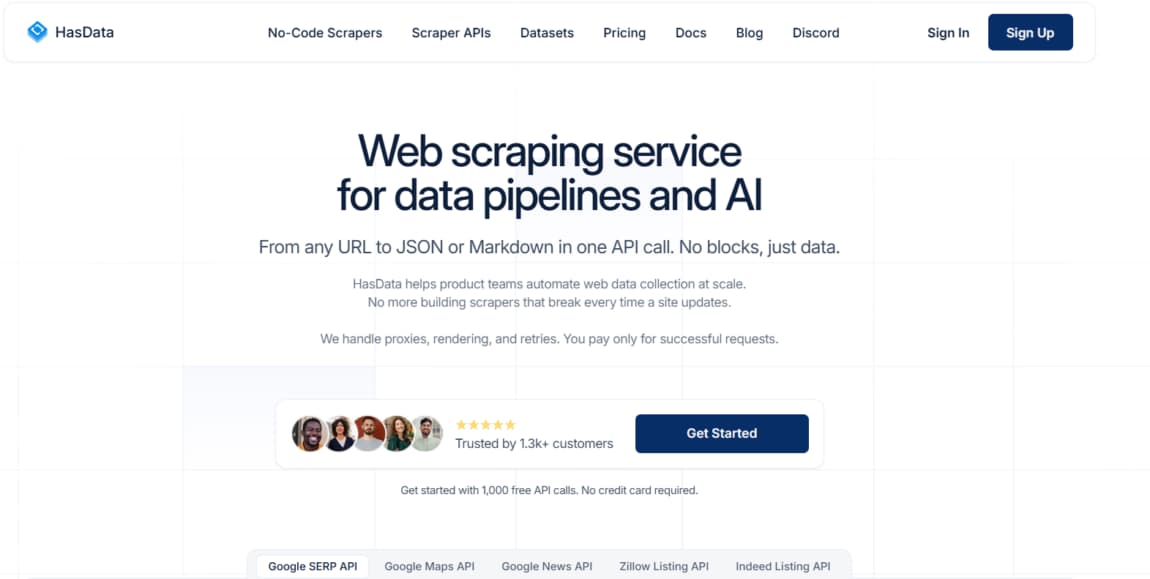
HasData Web Scraping API is designed specifically for large-scale scraping through a unified API endpoint. The system handles proxies, blocking countermeasures, content rendering, and page interactions internally without forcing users to manage separate components. This becomes critical when scraping moves from occasional experiments to production dependency.
A system that fails intermittently creates operational debt that compounds faster than anyone expects. The platform abstracts away infrastructure management while maintaining enough flexibility to handle diverse targets. HasData positions itself for environments where scraping must work consistently without engineering teams dedicating cycles to maintenance and troubleshooting.
Handling End-to-End Scraping Without Extra Systems
Managing proxies, rendering engines, and extraction logic as separate services multiplies operational complexity unnecessarily. Each component introduces new failure points and configuration overhead that demand ongoing attention from engineering teams. Unified systems collapse these concerns into a single interface where the platform handles coordination internally. Scaling scraping operations becomes manageable when the API shoulders infrastructure burdens.
The platform coordinates proxy rotation, JavaScript execution, and data extraction under one roof:
- Single API request for large-scale scraping;
- Automatic proxy rotation;
- Bypass of anti-bot systems;
- JavaScript rendering for dynamic pages;
- AI-based data extraction;
- Batch scraping and page interactions.
This approach reduces the ongoing maintenance burden significantly. It also supports stable long-term scraping operations that survive target website evolution without requiring architectural overhauls.
2. Import.io

Import.io focuses on enterprise-grade data extraction with structured pipelines that feed directly into analytics and business intelligence systems. Their platform emphasizes managed workflows where data quality and consistency take priority over raw request volume or scraping speed. Organizations that need reliable, structured data from complex web sources gravitate toward this operational model.
The tradeoff involves less flexibility for ad-hoc scraping tasks in exchange for production-grade reliability on defined extraction targets. Import.io suits environments where scraping constitutes business-critical infrastructure rather than occasional data collection. Their managed approach removes the burden of maintaining extraction logic across evolving target websites.
Data Extraction as a Managed Process
Enterprise data consumers rarely want raw HTML or unstructured page dumps from their scraping operations. They need clean, validated, analysis-ready datasets that integrate seamlessly with downstream systems and analytics platforms. Building and maintaining extraction logic that delivers this quality level demands significant engineering investment when handled internally.
Import.io structures their offering around managed extraction pipelines that transform web content into usable data:
- Enterprise-grade data extraction workflows;
- Structured data outputs;
- Integration with analytics systems;
- Scalable extraction pipelines.
Companies prioritizing structured data reliability over raw scraping flexibility will find this managed approach more aligned with enterprise data infrastructure requirements and long-term maintenance expectations.
3. Octoparse API
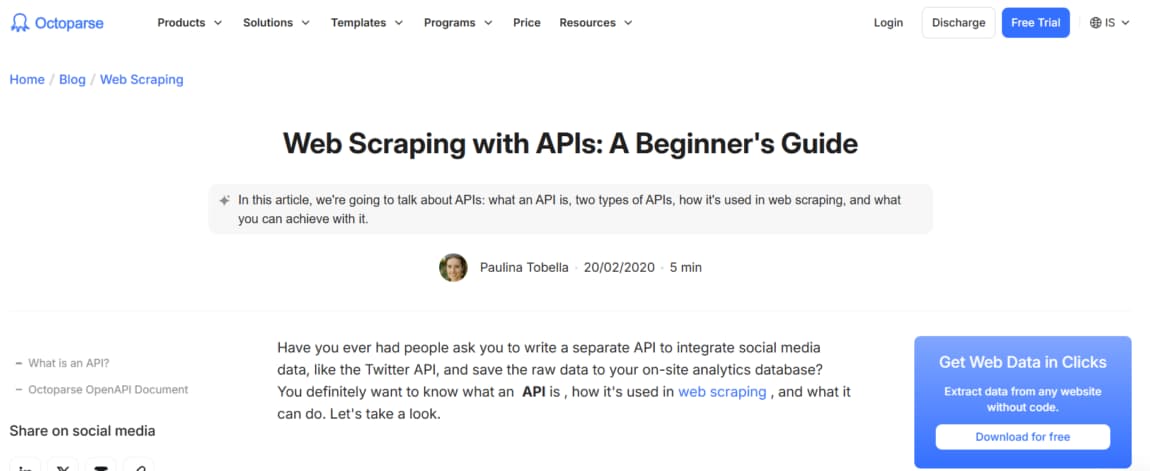
Octoparse originated from no-code scraping tools and later exposed API access for programmatic control. This hybrid background shapes their approach: complex page navigation and multi-step extraction sequences get built visually, then executed through API calls that integrate with automated workflows. Teams that need to scrape targets requiring login sequences, pagination handling, or conditional navigation benefit from this design philosophy.
The platform handles intricate interaction patterns that simpler request-based APIs struggle to replicate reliably. Octoparse suits use cases where the target website complexity exceeds what straightforward HTTP requests can reasonably handle. Visual workflow design reduces the engineering effort required for sophisticated scraping scenarios.
Handling Complex Extraction Scenarios
Some websites present extraction challenges through complex user flows rather than aggressive blocking. Multi-page checkout sequences, search-and-filter interactions, dynamically loaded content triggered by scroll events: these patterns demand substantial engineering when coded manually. Visual workflow construction reduces the complexity of modeling intricate navigation sequences while exposing finished logic through standard API endpoints.
Octoparse bridges the gap between no-code accessibility and programmatic control through:
- Visual workflow-based scraping logic;
- Support for dynamic content;
- Multi-step interaction handling;
- API integration for automation.
Complex targets that would require weeks of custom engineering become manageable through this combination of visual design and programmatic execution without sacrificing control over extraction logic.
4. Browse AI
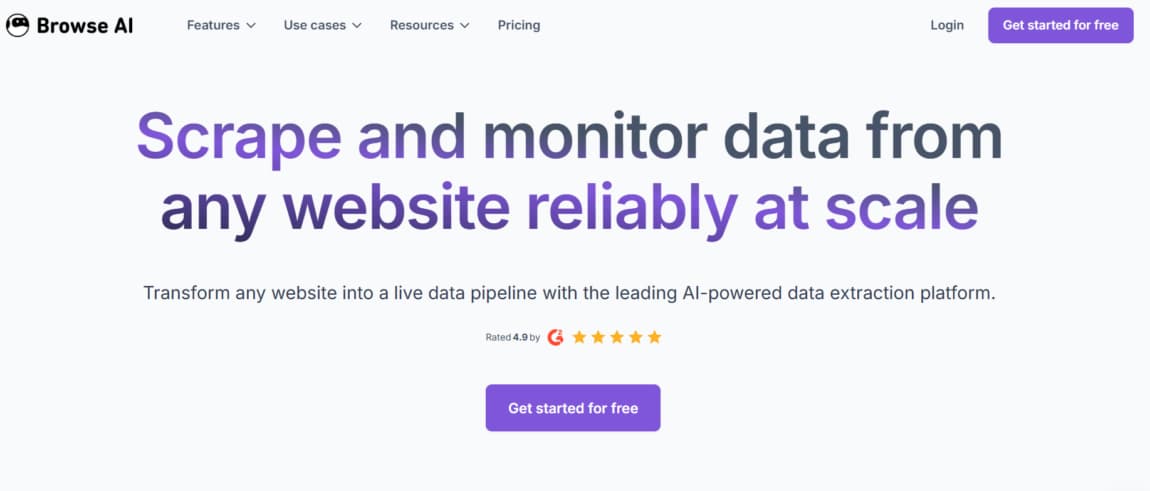
Browse AI approaches to web scraping through the lens of automation and monitoring rather than traditional request-response APIs. Their platform lets users define extraction robots that run on schedules, monitor websites for changes, and deliver updated datasets without manual triggering. This approach shifts the focus from one-time data collection toward ongoing intelligence gathering and change detection.
The tradeoff involves less granular control over request-level parameters in exchange for simplified deployment and maintenance. Browse AI fits teams that need data freshness and change detection without building monitoring infrastructure from scratch. Their automation-first philosophy reduces the operational overhead of repeated scraping tasks significantly.
Automating Repetitive Data Collection
Repeatedly scraping the same targets for updated information creates operational overhead that automation eliminates entirely. Manual processes break down when data needs refresh daily, hourly, or in response to specific trigger events. Monitoring workflows handle scheduling, change detection, and incremental updates without requiring constant human supervision or manual script execution.
Browse AI structures their platform around this automation-first philosophy:
- Automated data extraction workflows;
- Website monitoring capabilities;
- No heavy infrastructure required;
- Fast deployment and setup.
Lightweight scraping tasks and ongoing monitoring scenarios align naturally with this automation-oriented approach. Teams that prioritize deployment speed and operational simplicity over granular request configuration will find this model more practical for sustained data collection needs.
How to Choose the Right API for Your Setup
API selection should reflect actual production requirements rather than theoretical wishlists or impressive demo results. The correct choice for a small monitoring project looks nothing like the correct choice for massive-scale data extraction feeding mission-critical analytics. Testing candidates against real target websites under realistic load conditions reveals differences that specification sheets never capture.
Internal engineering capacity shapes viable options significantly. Platforms requiring extensive configuration deliver more control but demand technical resources that smaller teams simply lack. The sweet spot sits where API complexity matches your team’s ability to manage it without becoming a distraction. Before choosing, evaluate:
- Level of automation required;
- Type of target websites;
- Expected scale of requests;
- Data format requirements;
- Internal engineering resources.
These factors determine long-term success more reliably than any vendor’s published benchmarks or curated case studies.
Final Thoughts
Scraping reliability reveals itself only after deployment, when real websites start fighting back against extraction attempts. Demo environments and controlled tests mask every weakness that eventually causes production outages and incomplete datasets. Stable infrastructure matters more than feature count in the long run. Deep automation reduces the maintenance burden that accumulates silently over months of operation.
Scalability determines whether today’s quick solution survives tomorrow’s growing data needs without complete architectural overhauls. Choose tools based on how they perform when conditions get ugly rather than how they behave during five-minute trials against friendly targets. That gap between demos and real usage defines whether scraping becomes sustainable or just another operational headache.




More Stories
4 Leading GEO Platforms for Building AI Citations and Trusted Sources
6 PPF Installers in Chicagoland for Daily, Luxury and Performance Cars
5 Essential Forex Trading Platforms in 2026